Master’s scientific project
Laplace data completion and learned regularization
Three documented Master’s inverse-problem studies: learned spectral gains, covariance ablations and H¹ covariance shrinkage, including unmet criteria and public sources.
Scientific problem
Recover an inaccessible upper boundary trace from noisy averages measured on the lower boundary of a harmonic rectangle. The model assumes zero lower and lateral fluxes. High frequencies are exponentially attenuated: a small measurement perturbation can create a large reconstruction error.
This Master’s scientific project contains three successive studies, supervised by Pr. Chakir Tajani. It studies statistical regularization under controlled synthetic conditions.
Approach
An analytic generator with 128 cosine modes is independent of the nominal finite-difference inverse with 64 coefficients on a 65 × 17 grid. The benchmark therefore separates truncation and discretization from noise, missing sensors and height mismatch.
- Study 1 — learned spectral gains: 11 affine estimators, including signed/clipped gains, Wiener, Tikhonov and LMMSE. Validation uses two independent observations per object, without validation truth for parameter selection.
- Study 2 — covariance ablations: full versus diagonal covariance blocks in the same rank 12 input/output spaces; separate diagnostics isolate prediction outside the retained subspace.
- Study 3 — covariance shrinkage: mix the empirical signal covariance with an H¹ target of equal trace; compare the tuned mixture S with its γ=0 version M0. The original empirical LMMSE E and M0 are distinct estimators.
All three studies learn affine linear estimators from gains or covariances; no deep neural network is required. Studies 2–3 use supervised synthetic validation, so their tuning information differs from study 1.
Documented contribution
The public repository attributes the mathematical formulation, controlled benchmark implementation, analysis, academic reports and slides to Halhoul Mhamed. My documented deliverables include explicit modelling assumptions, frozen comparison protocols, paired evaluation, retained negative findings and figures linked to their numerical archives. The 12-page synthesis connects the three studies without new experiments.
Studies 2–3 disclose AI assistance for code, analysis and writing. Academic validation remains the responsibility of the author and supervisor. The estimators and covariance regularization have established precedents; the contribution is the structured comparison and its documented limitations.
Results, including unmet criteria
| Study | Primary comparison | Measured finding | Scoped conclusion |
|---|---|---|---|
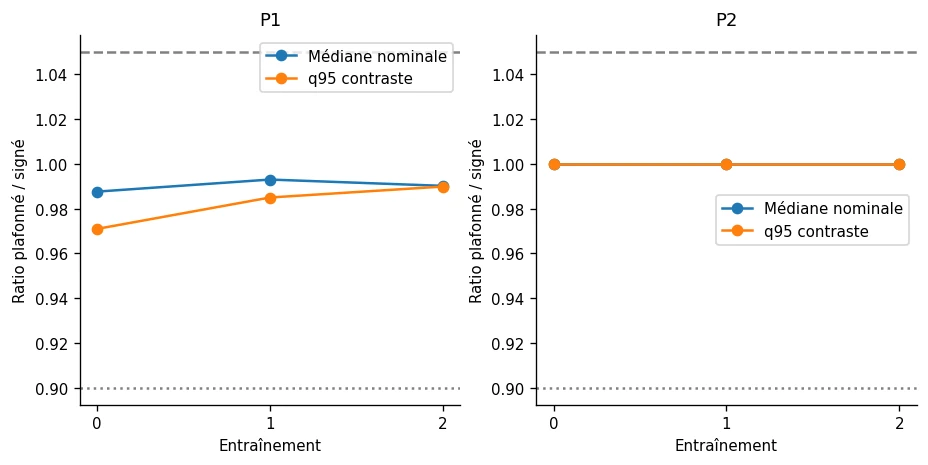
| 1 · Spectral gains | Clipped / signed; relative L² error, 95th percentile | P1 q95 ratio 0.9710–0.9899; P2 ratio 1.0000 | Useful 10 % benefit not established in any of 3 training sets. |
| 2 · Covariance blocks | Full / diagonal blocks at fixed rank 12; mean squared L² risk | F/D 0.3192–0.3218, across 5 training sets | Predeclared local criteria met; F remains worse than H¹. |
| 3 · Covariance shrinkage | S / M0 at N = 64; mean squared L² risk | Ratio of mean risks 0.9720 with full sensors; 1.0045 partial | Useful 3 % benefit not established; partial-sensor protection met. |
Study 1: the archive records 2,376,000 reconstructions and no detected numerical failure. The corrected q95 upper bounds never cross 0.90; clipping does not establish the required 10 % benefit. In the complete-sensor,height +5 % contrast, the measured ratios equal 1.

Study 2: at N = 256, 32 contiguous sensors and absolute noise 0.01, all five corrected comparisons satisfy the useful 5 % squared-risk reduction and 5 % q95 protection criteria. However, F has mean risk 0.051333 versus 0.016452 for H¹. Full LMMSE L has mean risk 0.012388 in this scenario, a secondary descriptive comparison; L worsens against H¹ with full sensors (+9.2 %) and rougher objects (+10.7 %). The archive records 1,920,000 method evaluations plus 1,200,000 diagnostics.
Study 3: at N = 64, the descriptive full-sensor reduction is 2.8 % in the ratio of mean risks. None of the five corrected upper bounds falls below 0.97, so the useful 3 % gain is not established. All partial-sensor protection bounds remain below 1.03. Roughness and height +10 % can degrade performance. Its archive records 1,920,000 reconstructions, including 480,000 diagnostics.
Counts include methods, repeated noise and diagnostics; they are not independent physical objects. A successful execution does not establish a scientific advantage. The primary bootstrap resamples paired physical objects and gives approximate bounds conditional on observed training sets.
Limits and interpretation
- Synthetic traces, zero-flux assumptions and a limited set of masks/noise/height shifts do not establish performance on physical measurements.
- Only three or five fitted training sets are observed; the bootstrap does not guarantee performance for all future trainings.
- Study 2 fixes rank 12; diagonal D frequently reaches a tuning-grid boundary. Study 3 considers 140 mixture candidates versus 20 for each comparator.
- The generator’s cosine coefficients are independent. Off-diagonal covariance in another basis does not prove newly discovered physical correlations.
- The studies use different losses and tuning information. Their effect sizes cannot be combined or ranked directly.
These are academic project reports, with no claim of algorithmic novelty, universal superiority or peer-reviewed publication.
Reports, slides, code and data
Study 1 and the synthesis are on main. Studies 2–3 are published on dedicated branches; the links below point to verified immutable commits. PDFs are authored in French; this project page and its synthesis page are available in both languages.