Comparative synthesis
Synthesis of three inverse-problem studies
A sourced academic synthesis connecting spectral clipping, covariance representation and H¹ shrinkage without new experiments or claims of general superiority.
A shared inverse problem
Three studies reconstruct an inaccessible boundary trace for Laplace’s equation from noisy lower-boundary averages. The common question is how statistical learning interacts with the stability and limited observability of the inverse problem.
This academic synthesis, authored by Halhoul Mhamed in the Master’s scientific project supervised by Pr. Chakir Tajani, is published in docs/synthesis/. The 12-page French report assembles the original findings and their provenance; it introduces no new campaign or statistical inference.
Three questions, three protocols
- Stability: does clipping signed learned gains reduce the 95th-percentile relative error by at least 10 %, while protecting the nominal median?
- Representation: at a common rank 12, do full covariance blocks reduce mean squared risk compared with their diagonal ablation by at least 5 %, while protecting tail loss?
- Estimation: does shrinking signal covariance toward an H¹ target improve full-sensor mean squared risk by at least 3 %, while protecting partial-sensor risk?
The three studies share an analytic generator and an independent nominal finite-difference inverse. Study 1 tunes with independent observations without validation truth; studies 2–3 tune with synthetic truth. Study 1 examines relative-error quantiles; studies 2–3 examine mean squared losses. Each reported ratio compares methods within its own protocol.
Documented synthesis contribution
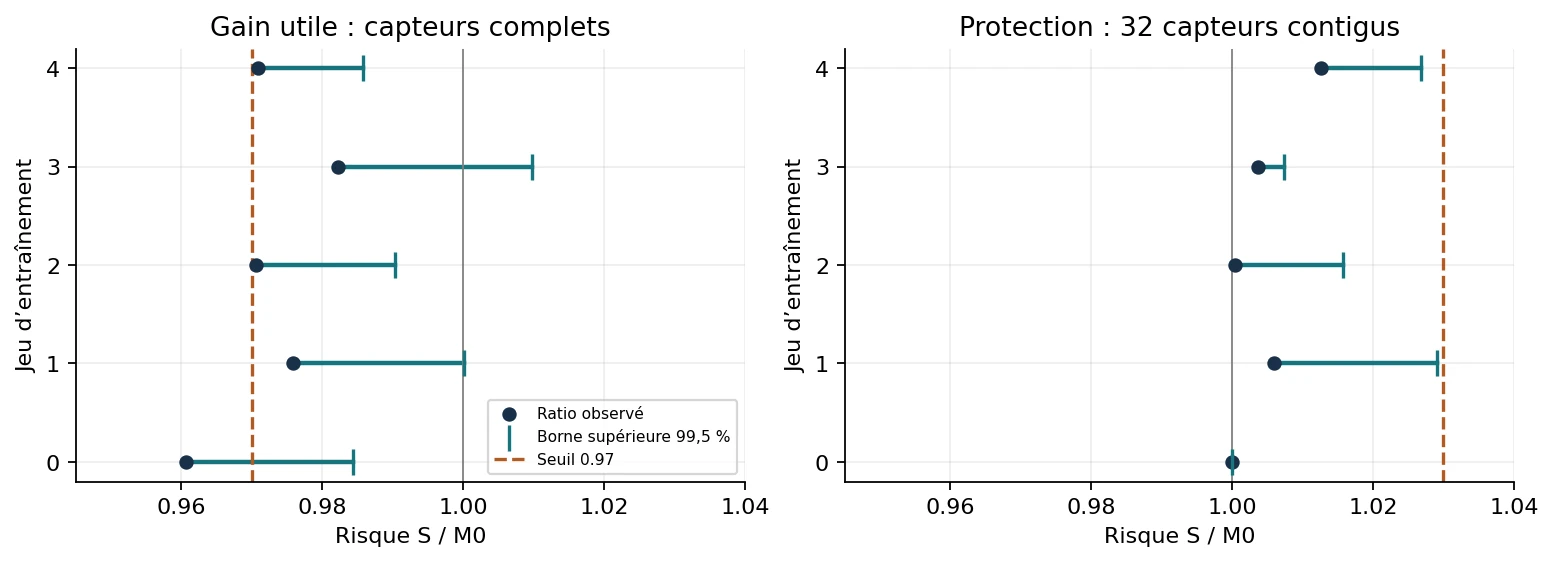
The synthesis distinguishes stability, reconstruction subspace and covariance estimation; preserves useful-gain failures alongside the local positive result; and connects the original reports, fixed protocols, archived data and figure scripts. Its two included graphics transcribe rounded tables from studies 2–3, without rerunning the simulator or bootstrap.
The public source bundle contains the PDF, editable LaTeX, transcribed CSV files, plotting script, figure provenance and checksums. The established affine estimators and covariance methods are not presented as a new algorithm.
What the studies establish
| Study | Primary comparison | Measured finding | Scoped conclusion |
|---|---|---|---|
| 1 · Spectral gains | Clipped / signed; relative L² error, 95th percentile | P1 q95 ratio 0.9710–0.9899; P2 ratio 1.0000 | Useful 10 % benefit not established in any of 3 training sets. |
| 2 · Covariance blocks | Full / diagonal blocks at fixed rank 12; mean squared L² risk | F/D 0.3192–0.3218, across 5 training sets | Predeclared local criteria met; F remains worse than H¹. |
| 3 · Covariance shrinkage | S / M0 at N = 64; mean squared L² risk | Ratio of mean risks 0.9720 with full sensors; 1.0045 partial | Useful 3 % benefit not established; partial-sensor protection met. |
Study 2’s local success: with 32 contiguous sensors, N = 256 and noise 0.01, F/D squared-risk ratios lie between 0.3192 and 0.3218. Corrected upper bounds lie between 0.3301 and 0.3350, below 0.95, and all tail-protection bounds pass. This roughly 68 % decrease is in squared risk for the specified comparison. F remains worse than H¹, and LMMSE gains in one setting coexist with degradation in others.
Study 3’s unmet useful-gain criterion: the full-sensor ratio of mean risks is 0.9720, a descriptive 2.8 % decrease. None of the five corrected upper bounds crosses 0.97. Protection under 32 contiguous sensors passes, with mean-risk ratio 1.0045; both requirements were needed for success. The nominal cosine-diagonal covariance comparator outperforms S in all five full/partial training comparisons.

Study 1’s negative comparison: point q95 ratios stay close to 1 under contiguous sensing and equal 1 under the complete-sensor height-shift contrast. No training set establishes the requested 10 % improvement. This is a negative comparative finding, not a numerical failure.
A small residual or bounded noise amplification does not guarantee a small reconstruction error. Statistical prediction of a weakly observed direction does not make that direction deterministically identifiable from each measurement.
Limits shared across the dossier
Synthetic signals, assumed zero fluxes, restricted geometries and three or five observed training sets do not establish physical validation or general superiority. Bootstrap bounds are approximate and conditional; noise repetitions and multiple method evaluations are not extra independent objects.
Study 2 tests one rank and a fixed parameter grid; study 3 gives the mixture a larger tuning budget (140 candidates versus 20 per comparator). The synthesis does not repeat the original experiments or a full independent statistical audit. Effect sizes cannot be added or used to rank the three studies, because their losses and tuning information differ.
These are academic project reports and a documentary synthesis; they are not listed as peer-reviewed publications.
Read the synthesis and trace its sources
The synthesis is published on main at commit 0b93908ce525. Original scientific archives are pinned to 0ea95cd (study 1), 57ab54e (study 2) and 867144d (study 3); the latter two studies are on dedicated public branches.