Master’s scientific project
Image denoising with partial differential equations
A documented comparison of heat and directional Perona–Malik diffusion, with synthetic-image PSNR/SSIM results, shared authorship and explicit limits.
The scientific question
When does gradient-dependent diffusion change the balance between noise reduction and edge preservation compared with linear heat diffusion? This scientific Master’s project studies that question on synthetic grayscale images with known clean references.
Academic course project · Module: Modélisation déterministe et applications · Supervised by Pr. Hatim Tayeq. Report and presentation by Halhoul Mhamed and Khalil Amraoui. This work is an academic project, with no claim of algorithmic novelty.
From PDE models to a controlled comparison
The implementation compares heat diffusion with exponential and rational Perona–Malik (PM) conductance. All three use explicit Euler time stepping, shared conservative fluxes, zero-flux boundaries and a four-neighbour directional grid. NumPy float64 computations run on CPU. The report establishes conservation of the mean and a discrete maximum principle under its time-step bound; these properties concern the implemented discrete scheme.
The archived study contains two 128 × 128 synthetic images, three Gaussian noise levels (σ = 0.025, 0.05, 0.10) and ten seeds. The same 60 noisy observations are shared by heat and eight PM variants: two conductances and four K values (0.025, 0.05, 0.10, 0.20). With Δt = 0.20 and Δx = Δy = 1, eight checkpoints from n = 0 to n = 80 produce 540 solver trajectories and 4,380 metric rows. Numerical evaluation uses unclipped arrays and a fixed data range of 1; only image display is bounded to [0,1].
My documented contribution
The repository attribution credits Halhoul Mhamed as the software author (recorded as “Mhamed Halhoul”): the numerical solvers, experiment pipeline, metrics, tests and result archives are available with their source code. Halhoul Mhamed and Khalil Amraoui jointly author the report and presentation. The public documents do not allocate individual writing tasks or proof authorship between them.
Measured results and counterexamples
The following fixed case uses the geometric-shapes image with σ = 0.10, n = 20 and K = 0.10 for both PM conductances. These are ten-seed averages, distinct from the single observation in the figures.
| Method | PSNR (dB) | SSIM |
|---|---|---|
| Noisy observation | 19.998888 ± 0.045764 | 0.216790 ± 0.001288 |
| Heat | 23.648227 ± 0.043245 | 0.801713 ± 0.002319 |
| Exponential PM | 28.344885 ± 0.235089 | 0.625369 ± 0.013708 |
| Rational PM | 34.652954 ± 0.297408 | 0.929244 ± 0.002746 |
Rational PM improves both scores relative to heat in this case. Exponential PM improves PSNR but obtains a lower SSIM than heat. The archived table preserves the exact source values. Dispersions are sample standard deviations, never confidence intervals.
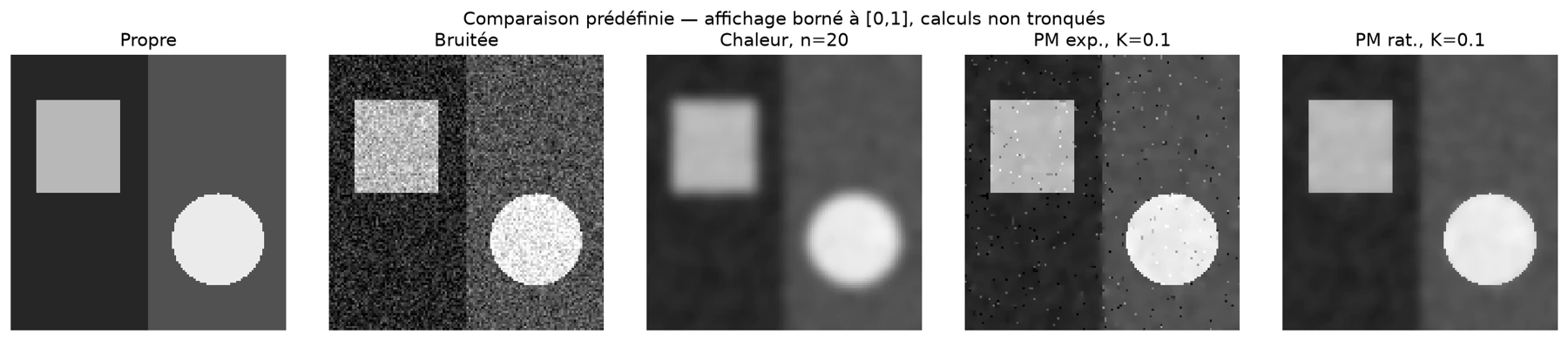

The result depends on conductance, K and stopping time. On the same image and noise level, exponential PM with K = 0.025 at n = 20 remains close to the noisy baseline (20.126870 dB; SSIM 0.219596). Rational PM with K = 0.10 drops from 34.652954 dB at n = 20 to 28.893715 dB at n = 80: it can also oversmooth. At lower noise (σ = 0.025), one heat iteration lowers PSNR from 32.040088 to 30.469103 dB while increasing SSIM from 0.664633 to 0.874023.
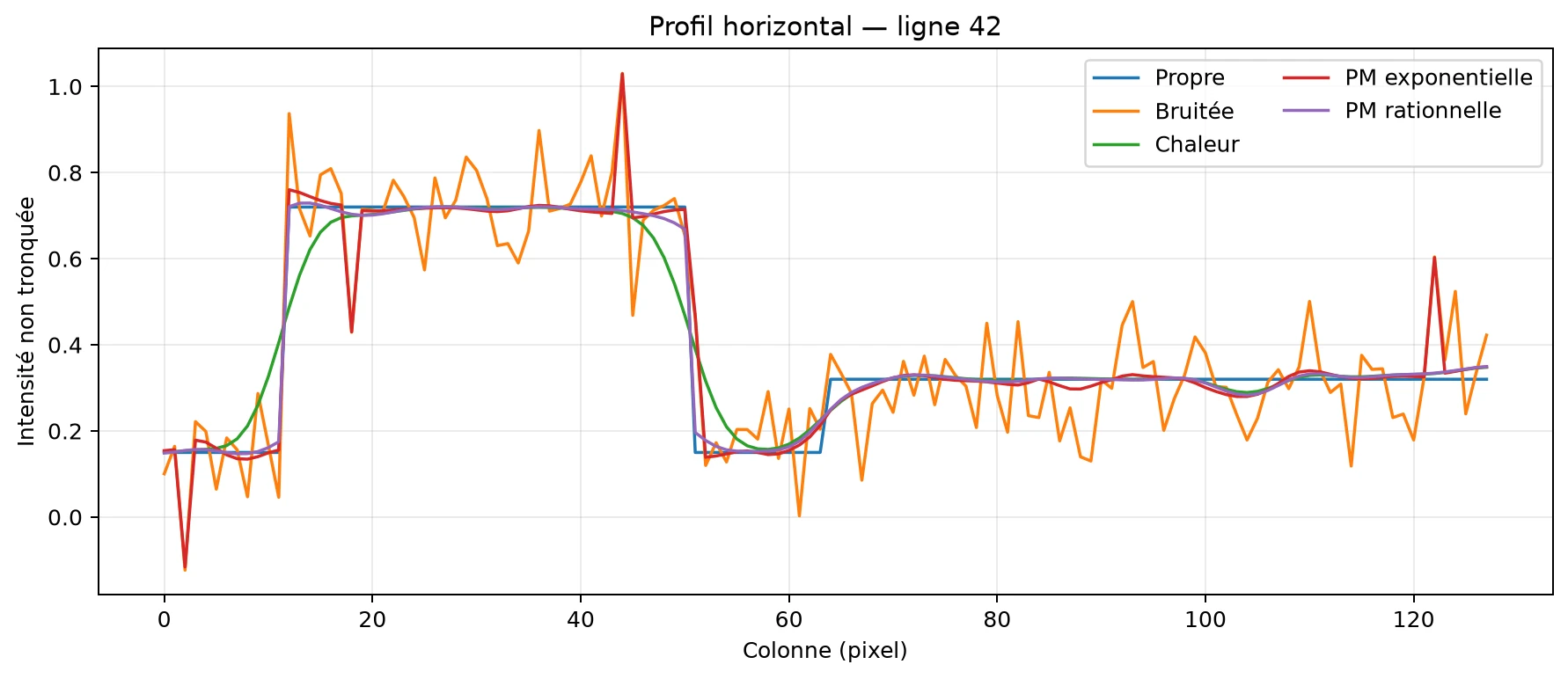

PSNR and SSIM select different best settings in 13 of 42 case/checkpoint comparisons. This describes the recorded grid; it is not a statistical test of superiority. The best settings found with the clean reference are exploratory oracles, not a tuning or stopping rule for an unknown photograph.
What the study does not establish
- Only two synthetic images and additive Gaussian noise were studied. Ten noise realizations do not replace ten different images; natural-image performance remains untested.
- The finite parameter grid was fixed after an exploratory phase. Some best scores occur at n = 80, the temporal boundary, so they are not global optima.
- The reused standardized Gaussian field makes image/noise cases partly dependent. No confidence interval, perceptual study or quantitative contour metric is supplied.
- The four-neighbour PM variant is directional and grid-dependent. Discrete stability does not resolve the well-posedness of continuous Perona–Malik, establish fully isotropic diffusion or prove nonlinear energy convergence.
- No general superiority or new algorithm is claimed. Selecting parameters without clean ground truth is future work.
Sources and reusable academic materials
Document edition: 155bbe46d38e0c526493e77af288f08e748ed584. Scientific code/data provenance: ae03109cdb2150b760e5a4b8bcffb56bba1b98e0. The latter identifies the inspected archive, not the historical execution commit, which the manifest does not record. The scientific repositories and archived experiments were read without modification or rerunning experiments for this portfolio.