Master’s scientific project
Neural approximation & thermal decisions
A controlled thermal benchmark relating neural value and sensitivity errors to physical decision quality. Master’s project supervised by Pr. Jamal Daoudi.
The question
Does accurate neural prediction produce a good physical decision? This Scientific Master’s project studies a scalar cooling-duration decision using a fixed, dimensionless thermal model. It separates two questions: whether sensitivity error is more strongly associated with decision error than value error, and whether derivative supervision improves the decision score.
The neural training parameters and the physical decision variable are distinct: training fits a surrogate temperature; the decision then minimizes its estimated temperature-plus-duration cost.
Approach & protocol
A 49-parameter tanh network (1–16–1) approximates the analytic temperature T(p) = exp(−π²p)/√2 + 0.2 exp(−4π²p) for p ∈ [0.02, 0.20]. The decision objective is Jλ(p) = T(p) + λp.
- M1_16: 16 value labels.
- M2_16: those 16 values plus physical derivatives at the same sites, using fixed analytic loss scales.
- M1_32: 32 value labels at different sites.
Twenty paired initializations compare all three conditions after 3000 full-batch Adam updates. Diagnostics use 257 held-out sites; decisions cover seven fixed tasks with 1025 candidates. Statistical uncertainty uses 2000 coupled bootstrap resamples of complete seed blocks. The main analysis uses 3000 updates; the 300-update snapshot is secondary.
M2_16 and M1_32 have equal conventional label cost only when q₁=1. Equal label cost does not equalize the sites, neural operations or runtime.
Documented contribution
I developed the controlled scalar benchmark, manual analytic neural and mixed gradients, value-only and derivative-informed losses, and stateful Adam continuation with saved checkpoints. I documented specialized mathematical bounds, label-cost accounting, paired statistical analysis and traceable scientific exports in LaTeX and Beamer.
This contribution is documented in the project’s contribution statement and report source. It applies established methods and is presented as a controlled experimental study.
Results: two distinct answers
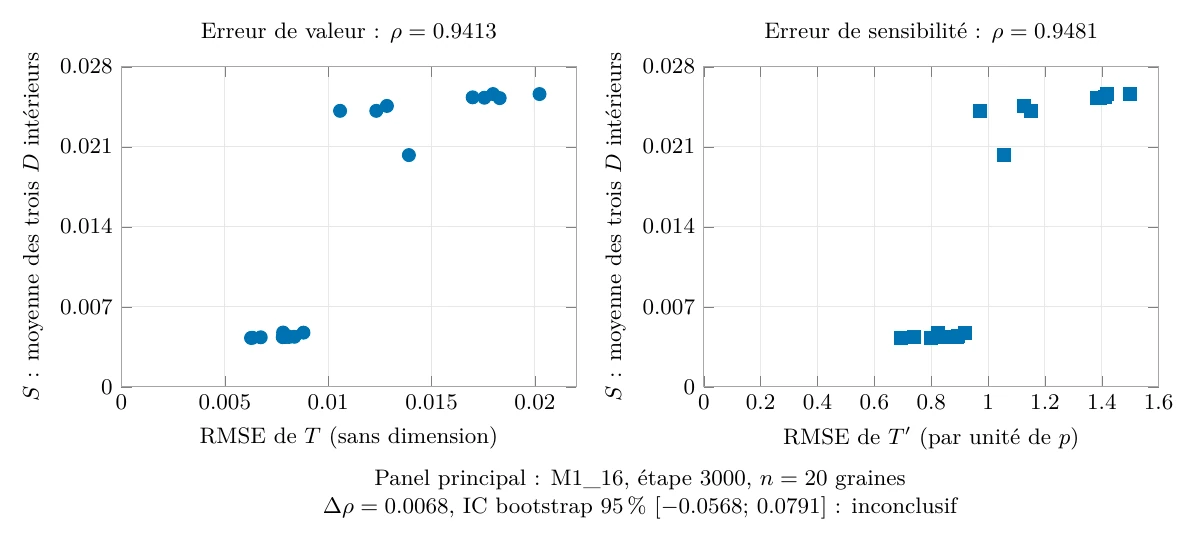
The primary sensitivity-association hypothesis remains inconclusive. In the main M1_16 panel, signed Spearman correlations are 0.9413 for value error and 0.9481 for sensitivity error. Their difference is Δρ = 0.0068, with a 95% bootstrap interval [−0.0568, 0.0791] that includes zero.
Mean paired decision-score differences favor M2 in the two planned method comparisons at 3000 updates:
| Paired comparison | Mean difference | 95% bootstrap interval | Pairs favoring M2 |
|---|---|---|---|
| M2_16 − M1_16 | −0.01006 | [−0.01460, −0.00557] | 13 / 20 |
| M2_16 − M1_32 | −0.00940 | [−0.01390, −0.00503] | 13 / 20 |
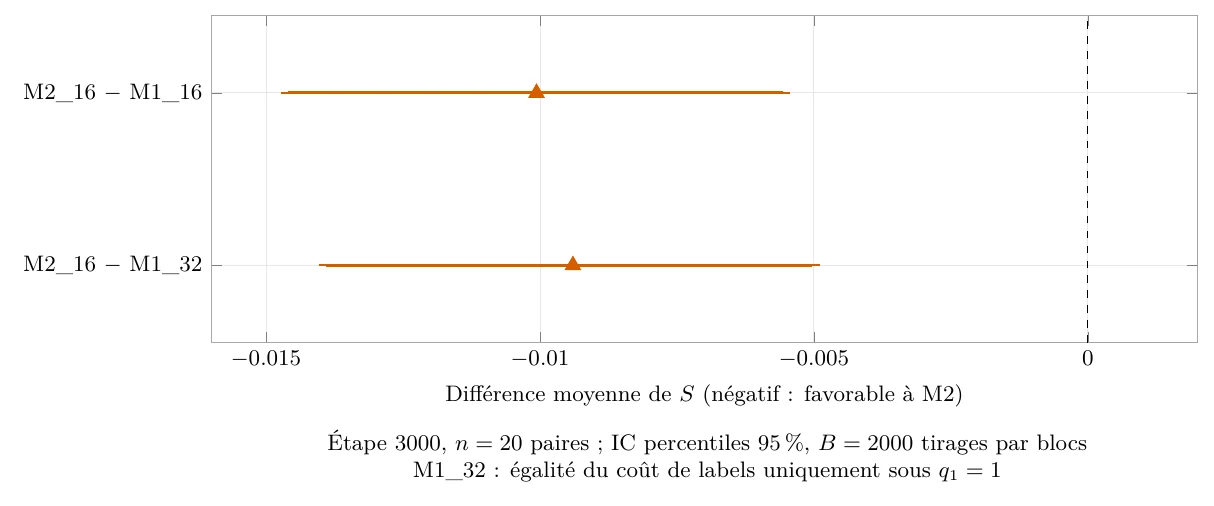
Seven seed pairs disfavor M2 in each comparison. For the fixed illustrative seed 20262001, M2 has lower value and sensitivity RMSE but a slightly worse decision score. At 300 updates, both M1 conditions have constant decision scores, so their rank correlations are undefined. These cases are retained in the study.
The score S averages three raw physical cost differences against a floating reference. It is not certified exact regret. A favorable method contrast does not settle the primary correlation hypothesis.
Limits & interpretation
- Twenty initializations of one noiseless scalar benchmark, with a fixed architecture and budget.
- The protocol was fixed after pilot inspection: an exploratory replication, without preregistration before all data.
- Grid and uniform-error bounds depend on their mathematical hypotheses. Discrete diagnostics and floating references do not certify total numerical error.
- Secondary intervals are exploratory and provide no simultaneous 95% guarantee.
- The results establish no general superiority, unique causal derivative effect, algorithmic novelty or out-of-sample validation.
- End-to-end campaign reproduction and numerical reproduction on multiple platforms remain unverified.
A proposed extension to a second physical case with measured value/derivative acquisition costs has not been executed.
Sources & research material
The report and slides are in French. Links below are pinned to the published documentary edition 155036d; scientific code, figures and results retain the provenance base 194561b.
Supervised by Pr. Jamal Daoudi, module Algorithmes métaheuristiques, Université Abdelmalek Essaâdi, Faculté Polydisciplinaire de Larache.